James Sheppard’s staged alibi
The Murder of Roger AckroydJames Sheppard’s staged alibi turns an apparently exact account of his departure from Roger Ackroyd’s study into a cover for murder. He used a timed Dictaphone to make Ackroyd appear to speak after his death, planted evidence suggesting an entrance through the window, and arranged a genuine but misleading telephone call to support his claimed movements. The alibi’s most important component was not an invented statement but an omission: Sheppard’s account recorded the times at which letters arrived and he left, while concealing what he did in the intervening ten minutes.
The Apparent Departure and the Hidden Interval
Sheppard tells Poirot that the letters were brought in at twenty minutes to nine and that he left at ten minutes to nine, with the letter still unread. In the original account, he even describes pausing at the door to consider whether anything remained undone before leaving the study. Those details are true, but their orderly sequence disguises an unreported interval. In the manuscript’s final confession, Sheppard identifies that gap as the time in which he completed the preparations for his alibi. Had he marked a break after the first sentence, he observes, the unexplained ten minutes might have attracted attention.
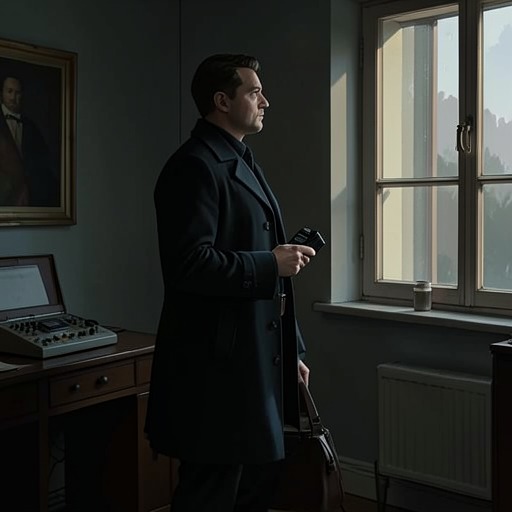
The physical arrangement of the study helped make the omission effective. Before leaving, Sheppard set the Dictaphone on the table by the window and timed it to operate at half-past nine. He drew the high-backed armchair away from the wall so that it concealed the table from someone entering through the door. The chair therefore functioned both as part of the staging and, later, as a clue: Parker reported its unusual position, and Poirot recognized that it hid something placed between the doorway and window.
Sheppard’s departure was not the end of his movements that night. As Poirot reconstructs them, Sheppard went out through the front door, ran to the summerhouse, put on Ralph Paton’s boots from the bag he had brought, and walked through the mud to leave bootprints on the study window ledge. He then climbed through the window, locked the study door from inside, returned to the summerhouse, changed back into his own shoes, and reached the gate by nine o’clock. Poirot says he tested the sequence himself and completed comparable movements in ten minutes. The apparently incriminating window evidence was thus part of the alibi’s design, not proof that Ralph had entered the room.
The Dictaphone and the False Appearance of Life
The recorded voice supplied the alibi’s central timing device. Poirot inferred that a Dictaphone had been taken from the table, in part because a representative of the Dictaphone Company had visited and no such machine was found among Ackroyd’s possessions. Sheppard had persuaded Ackroyd to let him adjust the device rather than send it back, giving him access to it before the murder. In his confession, Sheppard confirms that he altered the machine and brought it to Fernly Park in his bag.
At half-past nine, the machine—not Ackroyd—made the sound that led people to believe Ackroyd was alive. Poirot allows that the device might have been switched on by someone in the room or set off mechanically; Sheppard’s account supplies the mechanism, saying its timer worked on the principle of an alarm clock. The staged sound helped create a misleading chronology, while the machine itself had to be removed before it could expose the deception. When Sheppard later sent Parker to telephone the police, he described what he had done as little more than necessary. In fact, he had slipped the Dictaphone into his bag and pushed the chair back against the wall, restoring the room’s appearance and removing the two most revealing traces of his preparations.
A Genuine Call, a Misleading Message
The telephone call that brought Sheppard to Fernly Park presented Poirot with a problem because it had genuinely been put through from King’s Abbot station. Poirot initially considered whether Sheppard had invented the call, but learned that Sheppard had visited an American liner’s steward among his patients. The steward was due to leave for Liverpool that evening and would soon be at sea, beyond the immediate reach of inquiry. Poirot sent him a wireless message; the reply confirmed that Sheppard had asked him to leave a note at a patient’s house and to telephone the response from the station. The response was that there had been no answer.
The call, then, was real, and Caroline witnessed Sheppard take it. What the call did not establish was the content of the message: only Sheppard could vouch for what he said had been communicated. By arranging a call with a genuine external participant, he made a fabricated account harder to distinguish from a verified event. Its purpose was to explain his arrival at Fernly Park and give him the opportunity to remove the Dictaphone on which the timing of his alibi depended.
Poirot’s Reconstruction and the Narration’s Reversal
Poirot’s solution emerges by joining details that initially seem minor or unrelated: the chair pulled out from the wall, the missing Dictaphone, the unexplained delay on the walk to the gate, the window’s uncertain fastening, and the bootprints attributed to Ralph. He notes that Sheppard said he left at ten minutes to nine, while both Sheppard and Parker placed him at the lodge gates at nine. The usual walk took five minutes, not ten. Once Poirot questions Sheppard’s claim that the study window was fastened, the extra time becomes an opportunity rather than an inconsistency: it could accommodate the return to the house, the murder, the planted prints, the removal of the machine, and the final journey to the gate.
The staged alibi also determines how readers must reconsider Sheppard’s manuscript. He recounts his departure in polished, factually defensible sentences, but leaves the decisive action in the blank between them. Earlier, he presents himself as Poirot’s companion, carefully narrating the investigation and its discoveries. He later acknowledges that Poirot disclosed clues but withheld the impressions that would have connected them; the detective, not the narrator, fitted the pieces together. The final pages shift the manuscript from a record of the case to an exposure of its author: Sheppard’s precision was real, but it had been used selectively to hide his actions. At five in the morning, tired and aching from writing, he finishes the account he had once imagined publishing as the history of one of Poirot’s failures. The alibi’s collapse reverses that intended narrative, making the manuscript itself evidence of the crime it was meant to conceal.